Article
Be Canine Smart: Dog Bite Prevention Program
This program was developed to help people and dogs live harmoniously together in the community. You will learn a few preventive measures to help avoid unexpected confrontations with dogs. The program also explains dog behavior and shows you how to respond safely to an unfamiliar dog. See below for a PDF of the following information that also includes more details about recognizing dog behaviors and how to respond appropriately.
Considering that approximately 90 million dogs are owned by U.S. households, this information is valuable and practical.
Preventing Surprises
When approaching an unfamiliar house, your best defense is to be prepared. Identify whether a dog is present before attempting to approach an unfamiliar property. If possible, remain in your vehicle—your safest location—and take the following steps.
Be aware of dogs that may be loose nearby in the neighborhood: Someone may be walking their dog nearby or have allowed their pet out of the yard. Always politely ask an owner to restrain their dog and not allow the dog to jump on you. Remain in your vehicle if you see a loose dog in the area.
Evaluate the property for signs of a dog:
- Look for food bowls, feces, dog house, chain or a path worn in the grass.
- Before entering, try to draw a dog out by whistling or calling for the dog; honk your car horn; or jingle your car keys.
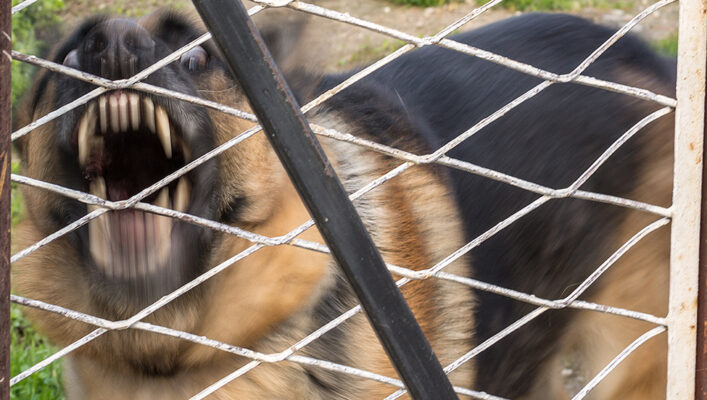
If a dog is on the property, assess if the animal is safely secured:
- The fence is of adequate height and strength.
- The fence has no holes underneath or on the side.
- The chain, rope or leash is strong and short enough for you to pass by safely.
- The windows and doors are secure if the dog is inside the house.
Always have something in your hand to protect against a surprise dog attack or charge. This item could be:
- A soft briefcase, purse, satchel, jacket or towel.
- Something soft and easily compressed, not hard.
Position yourself to protect against an attack:
- Put a barrier (bicycle, bag, etc.) between you and the dog.
- Assume the side posture and slowly back away from the dog to safety.
Smell is a dog’s most important sense. Their noses help them scent food, territory odors and even emotional states in other animals. This reliance on smell is why, when being introduced to an unfamiliar dog, you should always offer the back of your hand for the dog to sniff before petting or stroking the animal. However, as a general rule, petting should be avoided altogether.
If Suddenly Confronted by a Dog
The dog jumps at you and attempts to bite:
- Stop and present the soft object for the dog to grab.
- Shake and pull the object while the dog is grabbing it and slowly back away to safety.
- Once near your vehicle, let the dog have the object as you retreat inside the vehicle.
You have no object to distract the dog, and the dog bites or jumps on you:
- Stand quietly. Do not kick or attempt to hit the dog.
- Place your hands in fists around your head and neck for protection.
- Slowly, with your side facing the dog, walk to safety.
You are knocked down by the dog:
- Lie quietly in a fetal position.
- Place your hands in fists around your head and neck for protection.
- Remain in this defensive posture until the dog goes away or you are rescued.
You are chased while jogging or bicycling:
- Stop all movement. Do not run or shout.
- If on a bicycle, dismount and put the bike between you and the dog.
- Assume the side posture and slowly back away from the dog to safety.
When Bitten by a Dog
- Wash the wound thoroughly with soap and water. Contact medical professionals if needed.
- Report the incident to the appropriate local animal control. Give as much information as possible—the dog’s size, sex, color, age, features; where the dog and attack was; if the dog had been seen before; and so on—so that animal control may counsel the owner and help prevent others from being bitten. For your safety and the safety of the neighborhood, please report the dog bite incident.
If you see a loose dog or are aware of a situation where the owner is irresponsible for the care and control of a dog, call your local animal control to report the problem.
Topics