MCIT
Aggregate Rate Levels Remain Flat for 2027

 As work continues on establishing the cost of coverage for 2027, MCIT’s actuary delivered the annual rate analysis to the MCIT Board of Directors July 10. The setting of contribution rates is one of the most important decisions the MCIT Board makes that influences the bottom line of a member’s annual budget.
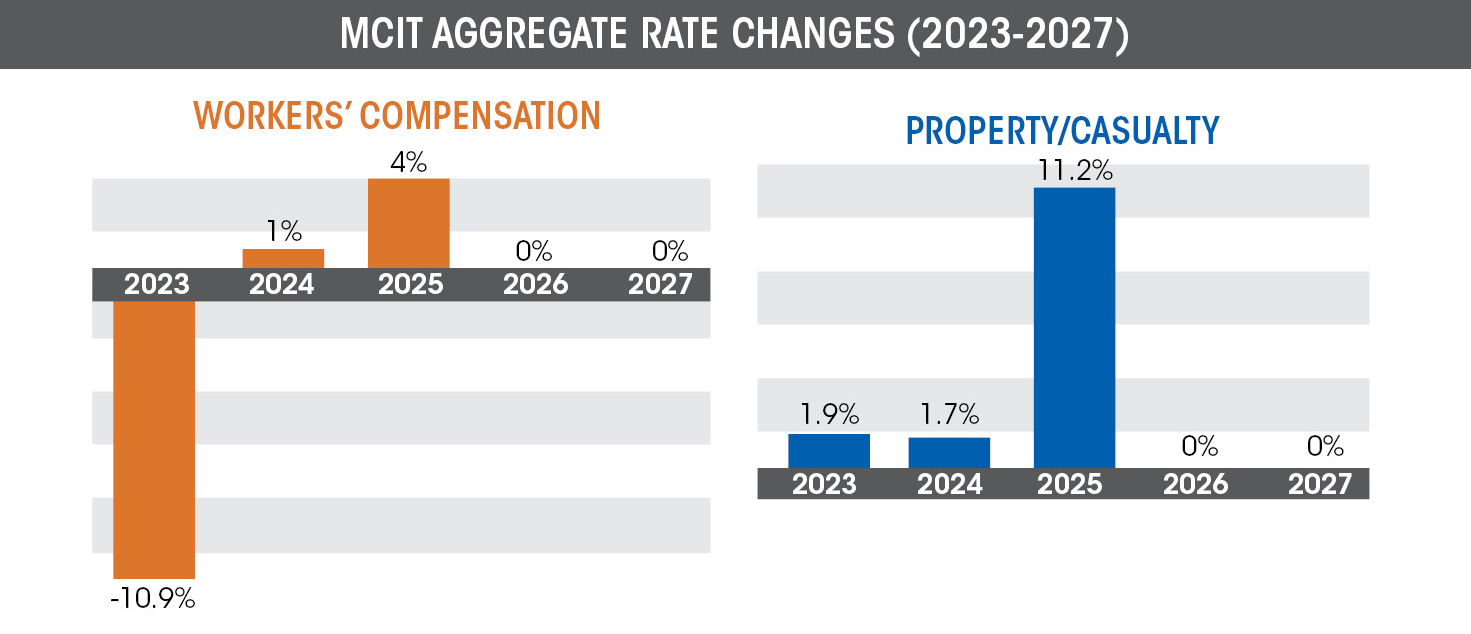
Scott Anderson of MCIT’s long-term partner, Actuarial Advisors, presented his report with the backdrop of claim stabilization and expected stabilization of reinsurance rates for 2027 in both the property/casualty and workers’ compensation divisions. In the end, the MCIT Board of Directors approved Anderson’s recommendation to again hold the aggregate rates flat for both divisions for 2027.
This is the second year in a row that the analysis indicated keeping aggregate rates at the current level for both property/casualty and workers’ compensation coverages. Generally, this means that actual claims developed as projected and that claims are expected to continue to be similar.
Rates for Individual Lines, Classification Codes Change
Aggregate rates reflect the net effect of rate changes (up and down) to the individual lines of coverage included in the property/casualty program (i.e., auto, general liability, property, public employees liability, etc.) and each individual payroll classification in the workers’ compensation program.
For the seven property/casualty lines of coverage, two lines have rate reductions, three rates are increasing and two rates remain unchanged for 2027 compared to 2026.
For workers’ compensation, members categorize payroll by position into approximately 30 different classifications that align with each employee’s job duties and the corresponding risk exposures. Each code has its own rate that can fluctuate from year to year, depending on the amount of payroll assigned to it and the volume of claims arising from it. Over half of these classifications saw either no change or a reduction in rate for 2027 which is in line compared to 2026.
Anderson noted that by holding aggregate rate levels flat, MCIT is collecting the same amount of contribution as in 2026, but changes to individual lines of coverage and classification codes better reflect from where claims come.
Member’s 2027 Contribution May Differ from 2026
The rate adjustments for each line of coverage combined with an individual member’s specific exposures will likely result in a different 2027 contribution, either higher or lower, from what the entity paid for 2026 coverage.
For example, the cost of property coverage is based largely on the total value of a member’s covered property. If a member sees little change in those values from 2026 to 2027 (say, just the 3.9 percent increase for inflation), the cost for property coverage in 2027 could be in line with or lower than the current year, as the contribution rate for buildings is actually lower in 2027 than in 2026.
However, if a member added significantly to the value of its covered property in 2026, perhaps with the addition of new buildings or renovations, the entity could see an increase in contribution even with a lower rate applied.
On the workers’ compensation side, a member’s 2027 contribution may be different from 2026 if it increased or decreased its payroll and depending on in which job classifications those adjustments occur.
Also, workers’ compensation contribution can be affected, sometimes significantly, by a change in the member’s unique experience modification factor. This factor reflects the member’s own claim activity, specifically, whether the member’s loss experience aligns with what is actuarially expected.
2027 Estimated Contribution/ Membership Renewal Notices Mailed Mid-August
With rate decisions made, MCIT staff is working to calculate and validate each member’s estimated contribution for next year. Notices will be issued to members by mid-August pursuant to the MCIT Bylaws.
Direct questions regarding 2027 contributions to MCIT underwriting at 866.547.6516 or underwriting@mcit.org.
How Contribution Is Calculated
 The recorded webinar “How MCIT Determines a Member’s Contribution” covers:
- The factors that the MCIT Board of Directors reviews when setting rates
- How those factors can affect rate calculations
- Reasons different lines of coverage have varying rates
- How standard rates are applied to a member’s specific risk factors