Article
Confined Space Entries
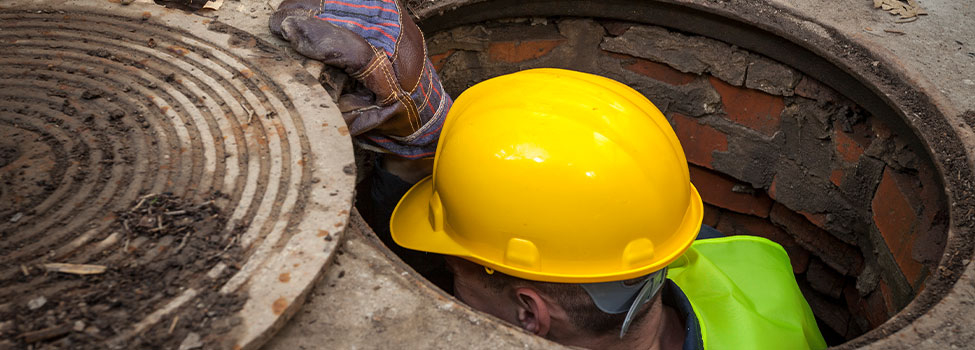
“Toxic Gas Kills Landfill Workers” was a headline depicting the death of four blacktop demolition landfill employees working in a well near Superior, Wis. The victims were overcome by a toxic atmosphere that contained hydrogen sulfide gas, the likely byproduct of decomposing material. It is believed that one or more of the victims entered the well in an attempt to rescue the others.
Confined spaces have potential to be dangerous places. Serious injuries and even death can result when workers enter a space with hazardous conditions and have difficulty getting out. Knowledge of these areas, and procedures for working in and around them, are important for the safety of employees.
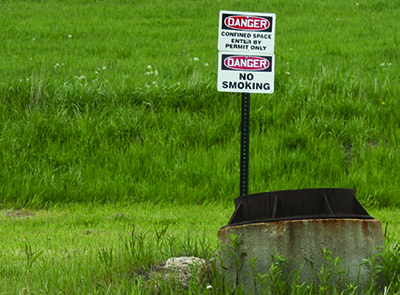
Storage tanks, utility vaults, machinery cabinets, crawl spaces and even trenches are examples of confined spaces. It is important to understand what defines a confined space. Even more important is understanding what makes this space a hazardous permit-required confined space and what to do to make entry safe.
Confined Space
To be considered a confined space, an area has the following three characteristics:
-
- It is large enough to work in.
-
- It has a restricted means for entry or exit.
-
- It is not designed for continuous employee occupancy. The space is only occasionally entered and not used on a routine basis. Often this space will have poor lighting or ventilation.
Permit-required Confined Space
A permit-required confined space meets the criteria above, plus has at least one of the following characteristics:
-
- Contains or has the potential to contain a hazardous atmosphere. This could include a flammable, toxic or oxygen-deficient atmosphere. Consideration should be given to confined spaces that have the potential to develop a hazardous atmosphere. For example, decomposing material within a confined space can create hazardous hydrogen sulfide.
-
- Contains a material that could engulf an entrant. This is typically a dry bulk material such as grain, but trenches and excavation also present the possibility of collapse or flooding.
-
- Has a design that could trap an entrant. This includes sloping floors or inwardly converging walls.
-
- Contains other recognized safety or health hazards. Electrical, fall, heat, noise and moving parts hazards are all examples of conditions that qualify.
If a space qualifies as a permit-required confined space:
-
- Employees must be notified of the presence of the permit-required confined space. This can be accomplished through signage and training.
-
- Determination must be made whether the space will be made enterable or worked in by employees. If not, measures must be taken to prevent entry into the space. If the space needs to be entered, a series of procedures must be followed and incorporated into a written program.
-
- Entry permits must be obtained and displayed outside of the permit-required confined space when work is being done. These permits require that pre-entry precautions have been followed and are signed by an assigned entry supervisor.
-
- All employees required to enter the permit-required space must be trained to assure that they have the understanding, knowledge and skills to work safely in this environment.
-
- If rescue service personnel cannot respond in a timely manner in the event of an emergency, trained individuals must be on hand with appropriate rescue equipment. Any authorized person entering the permit-required space must also be equipped with a chest harness and retrieval line or other equivalent rescue gear.
Many serious injuries and deaths have occurred when unprepared individuals attempt to rescue someone from a permit-required confined space without proper training or equipment. Employees should be made aware that only trained rescue service personnel are to retrieve an individual.
As required by the Occupational Safety and Health Administration (OSHA), the written program for permit-required confined space entry must include all of the following:
-
- Implement necessary measures to prevent unauthorized entry.
-
- Identify and evaluate permit space hazards before allowing employee entry.
-
- Test atmospheric conditions in the permit space before entry operations and monitor the space during entry. MCIT Note: These tests should be taken continuously during entry operations and done at multiple elevations within the confined space. Testing only next to the entrance may fail to identify hazardous gasses that sink to lower levels.
-
- Perform appropriate testing for the following atmospheric hazards in this sequence: first, oxygen; second, combustible gases or vapors; and third, toxic gases or vapors.
-
- Establish and implement the means, procedures and practices to eliminate or control hazards necessary for safe permit space entry operations.
-
- Identify employee job duties.
-
- Provide and maintain at no cost to the employee personal protective equipment and any other equipment necessary for safe entry and require employees to use it.
-
- Ensure that at least one attendant is stationed outside the permit space for the duration of entry operations.
-
- Coordinate entry operations when employees of more than one employer are working in the permit space.
-
- Implement appropriate procedures for summoning rescue and emergency services, and preventing unauthorized personnel from attempting rescue.
-
- Establish in writing and implement a system for the preparation, issue, use and cancellation of entry permits.
-
- Review established entry operations annually and revise the permit space entry program as necessary.
-
- Implement the procedures that any attendant who is required to monitor multiple spaces will follow during an emergency in one or more of those spaces.
Remember Lock Out/Tag Out
Lock out/tag out is another consideration in confined space entry. Lock out/tag out procedures need to be implemented where appropriate to control energy sources and gas and liquid lines. Minnesota OSHA (MNOSHA) requires lock out/tag out programs to:
-
- Place lock out devices on electrical sources of power or material flow.
-
- Eliminate pressure on pneumatic and hydraulic lines that activate a machine or mechanism.
-
- Block, clamp or secure spring tension and suspended mechanisms.
-
- Place individual lock out devices on equipment used by more than one employee.
Members should review Minnesota Rules 5207.0600 and OSHA standard 29 CFR 1910.147, the control of Hazardous Energy (Lock Out/Tag Out) for further information about lock out/tag out.
More Information
Members should consult 29 CFR 1910.146, Permit-required Confined Spaces, and Minnesota Rules 5207.0300-5207.0304; call MNOSHA Consultation at 1.800.657.3776; or contact MCIT loss control consultants toll-free at 1.866.547.6516 with questions and/or concerns about the hazard of working in confined spaces.
Topics