Article
Frequently Asked Questions: Cannabis and Employment

The legalization of recreational cannabis use by individuals 21 and older in Minnesota has spawned a number of questions about cannabis and employment from MCIT members. The information contained in this resource is intended for general information purposes only and does not constitute legal advice. Members should contact their legal counsel if they have any questions about workplace policies and testing employees for drugs, alcohol or cannabis. Members should also be aware of any collective bargaining implications when drafting or modifying drug, alcohol or cannabis policies.
Certain employees, including transportation employees who are required to hold a commercial driver’s license, may be required to undergo “drug and alcohol testing” under federal law. Marijuana is a scheduled drug under the federal Controlled Substances Act (21 U.S.C. § 801, et seq.,) and is still an illegal drug under federal law.1 This resource is not intended to and does not address federal testing requirements for those positions.
Legal Foundations Governing Cannabis Use in the Workplace
For general employees who are not subject to federal testing requirements, the Minnesota Drug and Alcohol Testing in the Workplace Act (DATWA), Minnesota Statutes Sections 181.950 to 181.957, provides the law related to testing employees for cannabis.
“Cannabis” is used here to refer collectively to cannabis flower, cannabis products, lower-potency hemp edibles and hemp-derived consumer products as these terms are defined in Minnesota Statutes Section 342.01.
1 Note: Hemp, which is defined as the plant cannabis sativa L. containing no more than a 0.3 percent concentration of delta-9-tetrahydrocannabinol (the psychoactive component), was removed from the definition of marijuana in 2018 and is not illegal under federal law (21 U.S.C. § 802(16).
Yes. DATWA applies to all persons or entities located or doing business in Minnesota and having one or more employees. This includes the state and all political or other governmental subdivisions of the state.
Employers may enact and enforce a work rule prohibiting the use, possession, impairment, sale or transfer of cannabis while an employee is working; on the employer’s premises; or operating the employer’s vehicle, machinery or equipment (Minn. Stat. § 181.952, subd. 3). The work rule must be in writing and in a written policy that contains the minimum information required by DATWA (see below).
Employers may discipline, discharge or take other adverse personnel action against employees for violating a written cannabis policy.
Generally, no. DATWA does not require employers to test any employees for cannabis, drugs or alcohol.
However, there are other state and federal laws that may apply and require testing. For example, federal regulations require the testing of some transportation-related employees, such as CDL drivers.2
2 See 49 CFR Part 40 (DOT regulations for testing); 49 CFR Part 382 (Federal Motor Carrier Safety Administration controlled substance and alcohol use and testing regulations).
It depends.
An employer may be required by state or federal laws, such as the federal Drug Free Workplace Act of 1988 or the Omnibus Transportation Employee Testing Act of 1991, to have a policy addressing drugs in the workplace and/or a drug testing policy. Marijuana is a scheduled drug under the federal Controlled Substances Act (21 U.S.C. § 801, et. seq.,) and is still an illegal drug under federal law.
For employers who do not have a legal requirement, it is a policy decision. There are various factors an employer may consider in deciding whether to enact a written policy, including whether testing will be implemented. For example, some employers who are not required to test any employees for drugs and alcohol or cannabis may want to focus on their employees’ job performance and not whether cannabis may be the cause of performance issues.
If an employer enacts and enforces a work rule prohibiting the use, possession, impairment, sale or transfer of cannabis at work, on the employer’s premises, or while operating the employer’s vehicles or equipment, the work rule must be in writing and in a written policy that contains the minimum information required by DATWA (see below). This applies even if the employer does not test employees for cannabis.
An employer that requests or requires employees to test for cannabis, drugs or alcohol, when allowed under DATWA, must have a written policy that complies with statutory requirements.
Unless otherwise required by state or federal law, MCIT takes no position on having a written cannabis policy or work rules. It is a policy decision for the employer to be undertaken in consultation with legal counsel.
Unless otherwise required by state or federal law, MCIT takes no position on testing employees for cannabis, drugs or alcohol, when legally permitted. It is a policy decision for the employer to be undertaken in consultation with legal counsel.
If an employer chooses or is required to enact a written policy, it must comply with DATWA. The Act requires a drug and alcohol and cannabis testing policy to include all of the following information:
- Identify employees or job applicants subject to testing under the policy
- Circumstances under which drug or alcohol and cannabis testing may be requested or required
- The right of an employee or job applicant to refuse to undergo drug and alcohol and cannabis testing and the consequences of refusal
- Any disciplinary or other adverse personnel action that may be taken based on a confirmatory test verifying a positive test result on an initial screening test
- The right of an employee or job applicant to explain a positive test result on a confirmatory test or request and pay for a confirmatory retest
- Any other appeal procedures available
Employers have discretion to include other information, but the policy must include all of the above information.
As a best practice, employers should also clearly state any rules the employer wants to impose related to the use, possession, impairment and distribution of cannabis while working or at the employer’s workplace. The rules should also include any discipline or other adverse personnel action that may be taken against an employee for violating the employer’s cannabis policy (Minn. Stat. § 181.953, subd. 10a).
Update Existing Employer Drug-testing Policies provides more information about this topic.
Yes, if the policy has not been updated since before 2023. The definition of “drug” in DATWA was changed with the 2023 legalization of adult-use recreational cannabis. For purposes of DATWA, cannabis is no longer a drug, and drug and alcohol testing generally does not include testing for cannabis, subject to some exceptions. Existing drug and alcohol testing policies may need to be updated to reflect the change in the law.
Under DATWA, an employer may discipline, discharge or take other adverse personnel action against an employee for the use, possession, impairment, sale or transfer of cannabis while the employee is working; on the employer’s premises; or operating the employer’s vehicle, machinery or equipment under any of the following circumstances:3
- If, as a result of consuming cannabis, the employee does not possess that clearness of intellect and control of self that the employee otherwise would have.
- If cannabis testing verifies the presence of cannabis following a confirmatory test.
- As provided in the employer’s written cannabis and cannabis testing policies, provided the policies are in writing and comply with statutory requirements.
- As otherwise authorized or required under state or federal law or regulations, or if a failure to do so would cause an employer to lose a monetary or licensing-related benefit under federal law or regulations.
Employers are not always required to test an employee for cannabis in order to discipline the employee for use, possession, impairment or distribution of cannabis at work. Only one of the circumstances in the list above explicitly requires an employer to test for cannabis. The other options authorize an employer to discipline, discharge or take other adverse personnel action against an employee without requesting or requiring a cannabis test and obtaining a positive test result.
For example, an employer has a written policy prohibiting cannabis use in the workplace and the policy allows for termination if it is violated. If the employer sees an employee using a cannabis product while working, the employer may terminate the employee as provided in the employer’s personnel policy. The employer is not required to test an employee for cannabis before disciplining or discharging the employee in this circumstance.
3 Minn. Stat. § 181.953, subd. 10a
Recreational use of cannabis is generally legal under Minnesota law for individuals 21 years old and older. Most employees will be able to use cannabis products while they are away from work and off duty so long as they are not impaired at work or while driving the employer’s vehicle and are not on the employer’s premises.
Employers are also prohibited from taking adverse employment action against an employee because of the employee’s status as a patient enrolled in a medical cannabis program or for off-duty use of medical cannabis, unless the failure to do so would violate federal law or cause the employer to lose monetary or licensing-related benefits under federal law.
There are some exceptions, however. Some employees can be prohibited from using cannabis both on and off duty under federal or state regulations. These include employees in positions that require a commercial driver’s license (CDL) and public safety employees who carry a firearm for their job. Also DATWA identifies seven types of job positions for which cannabis is still considered a drug (see below).
Members should contact their legal counsel before taking any action if they have questions about prohibiting employees from using cannabis while off duty.
Yes. Testing requirements for employees holding a commercial driver’s license have not changed. CDL drivers are subject to state and federal regulations. The federal Department of Transportation provides regulations governing drug and alcohol testing for employees who have positions that require a commercial driver’s license. These rules and regulations have not changed and still apply.
Members should continue to follow their drug testing procedures related to CDL employees and may enforce prohibitions against any use of cannabis for these employees.
No. Federal law prohibits any person who is an unlawful user of or addicted to any controlled substance, including marijuana, from shipping, transporting, receiving or possessing firearms or ammunition. A person who is a current user of marijuana is still defined as an “unlawful user” of controlled substances under federal law. Therefore, a current user of marijuana is prohibited from shipping, transporting, receiving or possessing firearms or ammunition.4
4 Bureau of Alcohol, Tobacco, Firearms and Explosives, ATF provides Clarification Related to New Minnesota Marijuana Law (May 30, 2023)
Yes. There are seven types of positions for which cannabis is still considered a drug under DATWA and testing for cannabis is allowed when an employer is authorized to test for drugs and alcohol.” These seven types of positions are:5
- Safety-sensitive positions
- Peace officers
- Firefighters
- Positions requiring face-to-face care, training, education, supervision, counseling, consultation or medical assistance to children; vulnerable adults; or patients who receive health care services from a provider for the treatment, examination or emergency care of a medical, psychiatric or mental condition
- Positions requiring a commercial driver’s license or requiring an employee to operate a motor vehicle for which state or federal law requires drug or alcohol testing
- Positions funded by a federal grant
- Any other position for which federal law requires testing of a job applicant or employee for cannabis
Because cannabis is still considered a drug for employees in the above positions, they may be tested for cannabis any time they may be tested for drugs or alcohol under DATWA. Federal law may also have its own testing requirements for some of these positions.
5 Minn. Stat. § 181.951, subd. 9
Safety-sensitive positions are jobs, including any supervisory or management position in which an impairment caused by drug, alcohol or cannabis usage would threaten the health or safety of any person (Minn. Stat. § 181.950, subd. 13).
Examples of safety-sensitive positions include jail personnel, patrol officers, director of emergency management and transport/court security deputies.6
6 See Law Enforcement Labor Servs., Inc. v. Sherburne County, 695 N.W.2d 630, 636 (Minn. Ct. App. 2005) (listing these positions and stating there can be no serious question that these positions have duties that implicate the public safety and health)
When an employee’s position is funded by a federal grant or when state or federal law requires testing of a job applicant or employee for cannabis, the employee is included in the seven positions for which cannabis is still considered a drug. Employees in these positions may be tested for cannabis when the employer is permitted to request or require drug and alcohol testing under DATWA.
DATWA may not apply to some employees and job applicants due to federal preemption. The employee and job applicant protections provided under DATWA generally do not apply to employees and job applicants where the specific work performed requires them to be subject to drug and alcohol testing or cannabis testing pursuant to any of the following:7
- Federal regulations that specifically preempt state regulation of drug and alcohol testing or cannabis testing
- Federal regulations or requirements necessary to operate federally regulated facilities
- Federal contracts where the drug and alcohol testing or cannabis testing is conducted for security, safety, or protection of sensitive or proprietary data
- State agency rules that adopt federal regulations applicable to the interstate component of a federally regulated industry and the adoption of those rules is for the purpose of conforming the nonfederally regulated intrastate component of the industry to identical regulation
7 Minn. Stat. § 181.957, subd. 1.
Generally no, but there are some exceptions.
It is unlawful for an employer to:
- Require pre-employment drug and alcohol testing or cannabis testing on an arbitrary or capricious basis.
- Require pre-employment cannabis testing as a condition of employment unless otherwise required by state or federal law.
- Refuse to hire an applicant solely because the applicant tests positive for cannabis on a pre-employment test authorized under DATWA unless otherwise required by state or federal law.
Employers may request or require pre-employment drug or alcohol testing for all positions if:
- The employer has made the applicant a job offer contingent on passing drug or alcohol testing;
- The same test is required of all applicants conditionally offered employment for that position; and
- The testing is done pursuant to the employer’s written drug and alcohol testing policy.
Because cannabis is now excluded from the definition of “drug,” pre-employment drug and alcohol testing generally does not include testing for cannabis. However, employers may include testing for cannabis in the pre-employment drug and alcohol testing for the seven types of positions discussed above.
If an employer requires an applicant to undergo pre-employment testing, all statutory notice requirements must be followed and the testing must comply with the oral fluid test procedures or be conducted by an accredited, certified or licensed laboratory following proper chain-of-custody procedures.
The employer may not withdraw a job offer contingent on passing a drug or alcohol test based on a positive test result from an initial screening test unless the result has been verified by a confirmatory test (Minn. Stat. § 181.953, subd. 11). If the job offer is withdrawn, the employer is required to inform the job applicant of the reason for its action.
Unless the pre-employment testing is required by federal law, employers must have a DATWA-compliant written policy in place prior to any testing.
Generally no, but there are some exceptions.
An employer may request or require an employee to undergo drug and alcohol testing as part of a routine physical exam no more than once per year (Minn. Stat. § 181.951, subd. 3). This includes cannabis testing only for employees in the seven positions listed above (e.g., safety sensitive positions, peace officers, positions requiring a CDL, etc.).
The employer must give the employee at least two weeks written notice that a drug or alcohol test may be requested or required as part of the physical exam.
Unless the drug and alcohol testing is required by federal law, employers must have a DATWA-compliant written policy in place prior to any testing.
An employer may request or require an employee to undergo cannabis testing and drug and alcohol testing if the employer has reasonable suspicion that the employee:8
- Is under the influence of drugs, cannabis or alcohol;
- Has violated the employer’s written work rules prohibiting the use, possession, impairment, sale or transfer of drugs, alcohol or cannabis while the employee is working; on the employer’s premises; or operating the employer’s vehicle, machinery or equipment if the work rules are in writing and contained in the employer’s written cannabis testing or drug and alcohol testing policy;
- Has sustained a personal injury as defined in Minnesota Statutes Section 176.011, subdivision 16, or has caused another employee to sustain a personal injury; or
- Has caused a work-related accident; or was operating or helping to operate machinery, equipment or vehicles involved in a work-related accident
Unless reasonable suspicion testing is required by federal law, employers must have a DATWA-compliant written policy in place prior to any testing.
8 Minn. Stat. § 181.951, subd. 5.
Under DATWA, “reasonable suspicion” is a basis for forming a belief based on specific facts and rational inferences drawn from those facts (Minn. Stat. § 181.950, subd. 12).
For an employer to have reasonable suspicion, the employer must observe current signs or symptoms to form the basis for its belief.
For example, some physical signs of drug or alcohol or cannabis use that may be observed include red or bloodshot eyes, dilated or constricted pupils, unsteady walk, vomiting, needle tracks or puncture marks, or a distinct odor of alcohol or cannabis.
There may also be observable behavioral indicators that could be signs of drug or alcohol use. A few examples are incoherent or slurred speech, bizarre behavior, lack of coordination, stumbling or staggering, disorientation or confusion, attendance problems, decline in performance, unexplained paranoia, possession of paraphernalia or possession of a substance that appears to be drugs or alcohol.
These should be behaviors that are new to the employee or are a change from the employee’s usual behavior.
Some commentators recommend that if an employer would like to require an employee to undergo cannabis or drug and alcohol testing because the employer believes it has reasonable suspicion the employee is under the influence of drugs, alcohol or cannabis based on observable signs or symptoms, as a best practice, the employer should also determine the following:
- Has some form of impairment been shown in the employee’s appearance, actions or work performance?
- Does the impairment result from the possible use of cannabis, drugs or alcohol?
- Are the facts reliable? Did the employer witness the situation personally, or is the employer sure that the witness is reliable and provided firsthand information?
- Are the facts capable of documentation?
- Is the impairment current, today, now?
If the answer to any of these questions is no, then testing based on reasonable suspicion should not be conducted.
Employers should document the specific facts and rational inferences that lead the employer to believe it has reasonable suspicion and that the employee should undergo cannabis testing or drug and alcohol testing.
Employers may also want to consider using a form to document the circumstances and observable facts that lead the employer to believe it has reasonable suspicion. This documentation can assist the employer if there is a dispute about whether the employer has reasonable suspicion. Examples of reasonable suspicion forms:
- League of Minnesota Cities Reasonable Suspicion Record of Observed Behavior
- Minnesota Department of Transportation Reasonable Suspicion Determination Report
- New Jersey Cannabis Regulatory Commission Workplace Impairment Guidance Sample Form
An employer may request or require an employee to undergo cannabis testing and drug and alcohol testing if:9
- The employer refers the employee for substance use disorder treatment or evaluation; or
- The employee is participating in a substance use disorder treatment program under an employee benefit plan
The employer may request or require the testing without providing prior notice to the employee during the evaluation or treatment period and for up to two years following completion of any prescribed substance use disorder treatment program. Treatment program cannabis testing may be requested or required of employees in any position.
Unless the drug and alcohol testing is required by federal law, employers must have a DATWA-compliant written policy in place prior to any testing.
9 Minn. Stat. § 181.951, subd. 6.
Generally, no.
An employer may request or require employees in safety-sensitive positions to undergo cannabis testing and drug and alcohol testing on a random basis (Minn. Stat. § 181.951, subd. 4) if this is included in the employer’s written policy under DATWA or otherwise required by federal law.
Only employees in safety-sensitive positions may be randomly tested for cannabis, drugs or alcohol. Employers may not request or require employees in other positions to undergo random testing.
Unless the drug and alcohol testing is required by federal law, employers must have a DATWA-compliant written policy in place prior to any random testing.
Yes. What You Need to Know About Drug, Alcohol, Cannabis Testing of Employees offers more information.

Click table to enlarge.
Yes. An employer must have a written testing policy that complies with statutory requirements before the employer may request or require an employee or job applicant to undergo drug, alcohol or cannabis testing under DATWA (Minn. Stat. § 181.951, subd. 1). Also, a number of statutes have requirements related to notice, testing and test results. For example, federal regulations requiring testing of some transportation-related employees, such as CDL drivers, have specific requirements related to testing.1
Before an employer can request or require an employee or a job applicant to undergo drug and alcohol testing or cannabis testing, when allowed, the employer must provide the employee or applicant written notice of the employer’s testing policy and provide the individual time to review the policy before testing.
The employee or applicant must also be provided with a form to acknowledge that the individual has seen the employer’s drug and alcohol testing or cannabis testing policy (Minn. Stat. § 181.953, subd. 6). If the employee or applicant refuses to sign the acknowledgement, the employer should note the refusal and that the policy was given to the individual before testing.
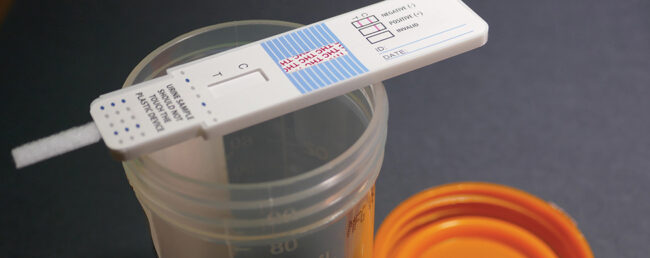
Oral fluid testing uses a saliva sample to detect the presence of drugs, alcohol, cannabis or their metabolites and does not require the services of a testing laboratory. The testing may be used as an alternative to using the services of a testing laboratory.
Yes. An employer may use oral fluid testing as an alternative to using the services of a testing laboratory if the employer is authorized to request or require drug and alcohol testing or cannabis testing under DATWA.
If the employer chooses to use oral fluid testing, it must still comply with pre-testing notice requirements (see above). However, sample retention requirements and employer chain-of-custody procedures under Minnesota Statutes, Section 181.953 do not apply.
There are also different requirements related to test results. The job applicant or employee must be informed of the test result at the time of the oral fluid test.
If the test result is positive, inconclusive or invalid, the job applicant or employee may, within 48 hours, request testing using the services of a testing laboratory at no expense to the individual. All of DATWA’s existing rights, notice and procedural requirements for laboratory testing (discussed below) apply to the laboratory test. If the laboratory test result is positive, the employee or job applicant may request a confirmatory retest at his or her own expense.
Except when oral fluid testing is used, employers must establish their own reliable chain-of-custody procedures to ensure proper record keeping, handling, labeling and identification of the samples to be tested. The procedures must include of the following:10
- Possession of a sample must be traceable to the employee from whom the sample is collected from the time the sample is collected until the time the sample is delivered to the laboratory;
- Sample must always be in the possession of, view of or placed in a secured area by a person authorized to handle the sample;
- Sample must be accompanied by a written change-of-custody record; and
- Individuals relinquishing or accepting possession of the sample must record the time the possession of the sample was transferred and must sign and date the chain-of-custody record at the time of transfer.
A licensed, accredited or certified laboratory must conduct the testing. The testing laboratory must conduct a confirmatory test on all samples that produce a positive result on an initial screening test (Minn. Stat. § 181.953, subd. 3).
10 Minn. Stat. § 181.953, subd. 5.
When laboratory testing services are used to conduct a test, the employer is required to inform the employee or job applicant in writing of the test result and of the right to receive a copy of the test report within three working days of receiving the result (Minn. Stat. § 181.953, subd. 7).
At this same time, if there is a positive test result on a confirmatory test, the employer must also notify the employee or applicant in writing of his or her rights, including the following:
- The opportunity to explain the positive result
- The right to request a confirmatory retest
- The limitations on employee discharge, discipline or discrimination, or the limitations on withdrawal of a job offer
The employer must give the employee or applicant written notice of the right to explain the positive test. The employer may also request that the employee or applicant indicate any over-the-counter or prescription medication the individual is taking and any other information relevant to the reliability of or explanation for a positive test result (Minn. Stat. § 181.953, subd. 6).
Within three working days after notice of a positive test result on a confirmatory test, the employee or applicant may submit information to the employer to explain the result. The employee may present verification of enrollment in the medical cannabis program as part of the explanation (Minn. Stat. § 152.32, subd. 3).
Or within five working days after notice of a positive test result, the employee or applicant may request a confirmatory retest of the original sample at his or her own expense (Minn. Stat. § 181.954, subd. 6 and 9). If the confirmatory retest does not confirm the original positive result, no adverse personnel action may be taken against the employee or job applicant (Minn. Stat. § 181.954, subd. 9).
The employer must also notify the applicant or employee of his or her rights under Minnesota Statutes, Section 181.953, subdivision 10 or 11, whichever applies. Subdivision 10 provides limitations on employee discharge, discipline or discrimination. Subdivision 11 provides limitations on withdrawal of a job offer. See below.
Yes. Test results are private data on individuals under the Minnesota Government Data Practices Act and generally may not be disclosed to another employer or a third-party without the written consent of the employee or job applicant tested.
However, a positive test result may be:11
- Used in an arbitration proceeding under a collective bargaining agreement, an administrative hearing under Minnesota Statutes Chapter 43A or a judicial proceeding if the information is relevant to the hearing or proceeding;
- Disclosed to a federal agency as required under federal law or in accordance with compliance requirements of a federal contract; and
- Disclosed to a substance abuse treatment facility for the purpose of evaluation or treatment of the employee.
11 See Minn. Stat. § 181.954
The employer may not withdraw a job offer contingent on passing a drug and alcohol test based on a positive test result from an initial screening test when laboratory testing services are used unless the result has been verified by a confirmatory test (Minn. Stat. § 181.953, subd. 11). This would include a test result positive for cannabis if the contingent offer was for one of the seven positions discussed above.
Unless otherwise required by state or federal law, an employer must not refuse to hire a job applicant solely because the applicant submitted to a cannabis test or drug and alcohol test authorized under DATWA and the result of the test indicated the presence of cannabis (Minn. Stat. § 181.951, subd. 8(b)).
If an offer is withdrawn, the employer must inform the applicant of the reason for the action (Minn. Stat. § 181.951, subd. 2).
Note: Employers should be careful in allowing a job applicant with a job offer contingent on the results of a drug or alcohol test or a cannabis test to start working before the employer receives the test results. When an employee tests positive for the first time, the employee may not be terminated until the employee is allowed an opportunity to participate in and complete a counseling or rehabilitation program (Minn. Stat. § 181.953, subd. 10). This could potentially apply if an applicant with a contingent offer is allowed to start working before the employer receives the test results.
An employer may not discharge, discipline, discriminate against, or request or require rehabilitation of an employee on the basis of a positive test result from an initial screening test that has not been verified by a confirmatory test.
But an employer may temporarily suspend the tested employee or transfer the employee to another position at the same rate of pay pending the outcome of the confirmatory test and any requested confirmatory retest if the employer believes that it is reasonably necessary to protect the health or safety of the employee, co-workers or the public.
If the confirmatory test or retest is negative, an employee who has been suspended without pay must be reinstated with back pay (Minn. Stat. § 181.953, subd. 10).
An employer also may not discharge an employee who tests positive on a confirmatory test if it was the first positive test result for the employee on a drug or alcohol test or a cannabis test requested by the employer unless the following conditions have been met:12
- The employer has given the employee an opportunity to participate in, at the employee’s expense or pursuant to coverage under an employee benefit plan, either drug, alcohol or cannabis counseling or rehabilitation program (whichever is more appropriate, as determined by the employer after consulting a certified chemical use counselor or a physician trained in the diagnosis and treatment of a substance use disorder); and
- The employee has either refused to participate or has failed to successfully complete the program, as evidenced by withdrawal from the program before completion or by a positive test result on a confirmatory test after completing the program.
12 Minn. Stat. § 181.953, subd. 10
Generally, an employer is not liable for compensation if an injury was intentionally self-inflicted or the employee’s intoxication is the proximate cause of the injury. The employer has the burden of proving these facts (Minn. Stat. § 176.021, subd. 1).
Topics