Article
Hearing Conservation Plans
Many factors can contribute to hearing loss; however, one of the most preventable causes of hearing loss occurs from what is known as noise-induced hearing loss. Loud noises can damage structures within the ear, potentially causing permanent damage. Further exposures can cause additional damage, leading to cumulative effects that accelerate natural hearing loss due to aging. When employees use equipment that produce loud noises that can cause hearing loss, the employer needs to follow a hearing conservation plan.
There is currently no medical procedure that can fix hearing loss, and hearing aids do not restore lost hearing. This gradual hearing loss can happen so slowly that individuals often do not notice the hearing loss until the damage is done. Other times, hearing loss can occur quickly from extremely loud events, such as explosions, gunfire or other loud noises near the ear. Fortunately, unlike other causes of hearing loss, there are methods to detect and prevent the damage from excessive noise.
The OSHA Hearing Conservation Plan is designed to address factors contributing to potential hearing loss. The primary question to address is whether the operator is exposed to an eight-hour time-weighted average of at least 85 decibels, measured on the A-scale (dBA). This measurement is a function of the decibel level of the equipment combined with the amount of time it is used by the operator each day.
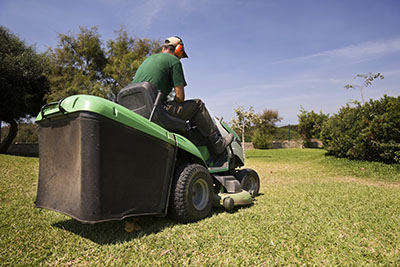
In the public sector work environment, examples of equipment that may expose an employee to the 85 dBA eight-hour average include chain saws, mowers, glass crushers, road graders and other heavy equipment. If employees are exposed at or above this level, known as the “action level,” the Occupational Safety and Health Administration (OSHA ) requires a hearing conservation program (HCP) that is compliant with 29 CFR 1910.95. This exposure is measured without regard to the sound suppression provided by the use of personal protective equipment.
The charts below provide points of reference to determine which tasks you want to monitor with a sound level meter or noise dosimeter. For example, consider that MCIT loss control consultants have measured the following short-term noise exposures at MCIT member facilities: lawn tractor, 89 dBA; road grader, 91 dBA; push mower 94 dBA; chain saw, 112dBA.
Acquire Decibel Levels
Once a member has determined which equipment needs further evaluation, the organization should obtain their decibel levels during operation. Many items, such as weed eaters, mowers and chain saws, have decibel ratings shown on the manufacturer’s plate that is affixed to the equipment. If a plate cannot be found, the owner’s manual may contain the information, or the member can call the manufacturer. This information is less likely to be available on older equipment and highway-use equipment, such as plows or graders.
Actual noise may also differ as equipment ages or is modified. If unsure of these findings, a member may need to measure suspect noise sources.
Two basic instruments can be used to measure noise. First, a direct reading sound level meter (SLM) can be used to screen areas. By holding this equipment near the hearing zone of the employee, one gets a picture of what the noise level is. If it is consistently below 85 dBA, no further monitoring is needed. If, however, the sound level is hovering around 85 dBA or is consistently greater, a more precise measurement should be taken to determine the exact exposure. MCIT loss control consultants are available to do a screening with an SLM for members.
The second instrument used to measure sound is the dosimeter, which gives more accurate data, because it measures noise over a longer period. It works by attaching the unit’s microphone near the hearing zone of the employee being monitored and stays in place for an entire work shift. At the end of the shift, the unit calculates the eight-hour time-weighted average. A reading of 85 dBA or greater will result in inclusion of the monitored employee in the hearing conservation program.
To determine if measuring noise with a sampling device is required, the member should consider the maximum number of hours per day that an employee is exposed to the noise source together with the decibel rating supplied by the manufacturer (or an estimate if the information is unavailable). If a chain saw manufacturer states that a saw runs at 100 decibels and it is used approximately one to two hours per day, a closer look should be taken.
Remember, the goal is to measure actual employee exposure to noise, not just the noise level in a given area. For example, a generator room that is measured at 100 dBA is not a concern unless employees spend close to two hours per day in it.
When a Hearing Conservation Plan Is Required
If a member discovers that an employee is exposed to noise at an eight-hour time-weighted average of 85 dBA or greater, the employer is required by OSHA to develop a hearing conservation program (HCP).
If an employee is exposed at an eight-hour average of 90 dBA or more, he or she is overexposed to noise. Permanent hearing damage could occur if preventive steps are not taken. All employers with employees exposed at the action level or above are required to test employees’ hearing annually and record any permanent hearing loss on their OSHA 300 logs.
Developing a hearing conservation program is a fairly involved process. It includes documenting noise exposure levels, reducing noise exposure through engineering controls, providing employees with training and hearing protection, and annual audiometric testing for affected employees, among other requirements.
If members have questions about determining their employees’ exposure levels or with setting up an HCP, they are encouraged to contact their MCIT loss control consultant toll-free at 1.866.547.6516.
NOISE FACTS
Noise is measured on a logarithmic scale. Roughly every 10 dBA increase in noise is perceived by the ear as being twice as loud (90 dBA seems twice as loud as 80 dBA).
Noise is additive, but 2+2 does not equal 4. For example, if there are two noise sources, one at 88 dBA and one at 90 dBA, and you are standing between them, the measured noise level would be about 92 dBA.
There are three decibel scales (A, B and C). The A-scale is used because it most closely approximates the sensitivity of the human ear.
A rule of thumb is that, if you have to shout to be heard three feet away, the level is probably at least 85 dBA.
OSHA Daily Permissible Noise Exposures |
|
|---|---|
| Hours Per Day | Sound Level (dBA) |
| 8 | 90 |
| 6 | 92 |
| 4 | 95 |
| 3 | 97 |
| 2 | 100 |
| 1.5 | 102 |
| 1 | 105 |
| 0.5 | 110 |
| 0.25 or less | 115 |
Noise Levels of Common Sounds |
|
| 80-90 Decibels | 100+ Decibels |
| Hand Drill | Snow Blower |
| Push Mower | Leaf Blower |
| Road Grader | Chain Saw |
| Tractor | Circular Saw |
| Shop Vacuum | Car Horn |
The information contained in this document is intended for general information purposes only and does not constitute legal or coverage advice on any specific matter.
Topics