
Article
Potholes: Protect Road Maintenance Decisions with a Written Policy
Provided by Kenneth H. Bayliss, Attorney, Quinlivan & Hughes P.A.
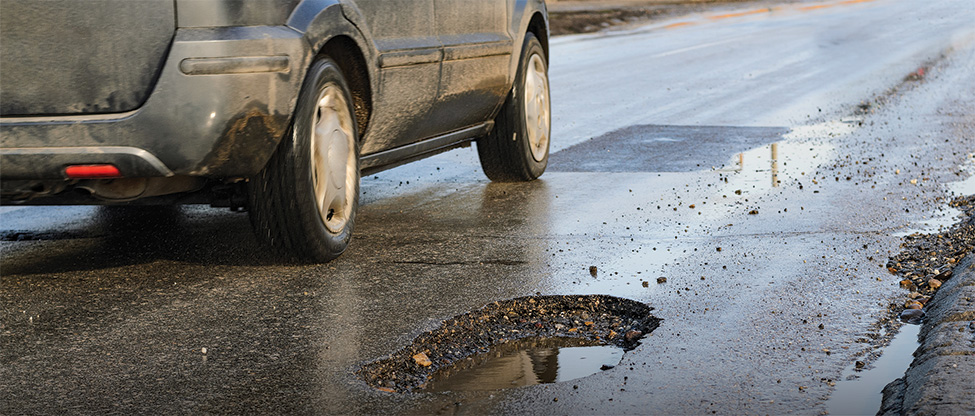
County road budgets have been under increasing pressure for decades, and counties frequently find themselves unable to fund highway reconstruction and repaving projects with current budgets. Roads designed with a 20-year life may be pushed out to 30 years or more before they can be rebuilt or reconstructed. The inevitable consequences of underfunding road maintenance are potholes and other pavement defects.
Obviously, pavement defects create safety and liability concerns, which give rise to several types of claims and lawsuits:
- Damage to vehicles
- Accidents caused by vehicles losing control because of potholes or pavement defects
- Injuries to bicyclists
- Injuries to persons walking roadways
Every county has a budgeting process that it goes through with respect to roadways. Adopting written policies to govern the way they deal with potholes and pavement defects can assist in consistent decision-making and preserving immunity protections.
Benefits of a Written Policy
Minnesota extends many immunity protections to counties that insulate them from liability. These immunity protections are of two primary types:
- Decisions that involve the exercise of discretion
- Decisions that involve policy decisions
Although these protections may be available without a written policy, having one removes any suggestion that the county is simply coming up with an after-the-fact rationalization when an accident or loss has occurred.
Formerly, the courts were willing to accept affidavits or declarations of road maintenance personnel asserting that unwritten policies existed. More recently, decisions have called into question assertions that there were unwritten policies and subjected such assertions to close scrutiny.
A written policy removes any question about whether a policy actually exists and helps show that the county thought about the issues in a way that is more likely to allow it to win a case based on governmental immunity. In short, written policies help win lawsuits.
Issues to Address in a Pothole, Pavement Defect Policy
A pothole or pavement defect policy should consider a number of questions, including:
- What constitutes a pothole or pavement defect?
- Will pothole repair be conducted on a scheduled basis, in response to particular complaints by the public or both?
- How will records be kept concerning public complaints?
- Which roads receive priority for repairs (first, second, etc.)?
- Does location of the potholes matter (at the side of the road vs. in a traveled lane)?
- What time of year will repairs be made?
- Who in the department will oversee pothole and pavement defect repairs?
See example of a pothole/pavement defect policy
When the Written Policy Conflicts with Budgetary, Other Issues
Adopting a policy means that the county should attempt to follow it. Given that budgetary constraints or other issues may at times make it difficult or impossible to follow a policy, the policy should include a disclaimer stating that it is not absolute and allows flexibility depending on budgetary, safety, personnel and environmental concerns.
If such a disclaimer is not included, the policy could be considered absolute, and this might interfere with the county’s ability to assert an immunity defense in some cases. With such a disclaimer in place, however, the county does not need to be concerned that its written policy would actually create liability or interfere with the ability to assert an immunity defense.
The example policy includes such a disclaimer.
Steps After Adopting a Policy
Adopting a policy is not the end. It is a means of improving maintenance and protecting the county from claims. After the policy is adopted, the county should take steps to make it effective:
- Make sure that any written policy adopted is maintained in an appropriate place, such as county maintenance manuals.
- Disseminate the policy within the department and educate maintenance personnel on what the policy means and whom within the department is supposed to implement specific parts of the policy.
- Keep and maintain records of public complaints about pavement defects.
- Make note and maintain records of any instances that the policy cannot be followed because of budgetary, safety, personnel or environmental concerns.
- Periodically review the policy with road maintenance staff to ensure that it is still being followed. Otherwise, the passage of time may lead county maintenance personnel to forget about or ignore it.
Topics